
implant rupture & leak detection
Breast Ultrasound Screening (Plus Implant Integrity)
Did you know 1 in 10 women will experience an implant rupture within 10 years? (source)
Ultrasound is a comfortable, compression-free way to screen breast tissue and the underarm area for abnormalities. If you have breast implants, the same visit can also include an implant integrity scan to look for common imaging signs of rupture or leak, like a folded shell, free silicone, and other irregularities.
Schedule a breast ultrasound screening to check for implant rupture or leaks, plus a scan of your breast tissue.

Checks implant integrity (rupture/leak)
Ultrasound can show common imaging signs tied to rupture/leak—like a collapsed/folded shell, free silicone, and other irregularities.

Helps you follow FDA surveillance guidance
FDA-recommended timing: first ultrasound 5–6 years after surgery, then every 2–3 years after that for silicone gel-filled implants.

Compression free and generally comfortable
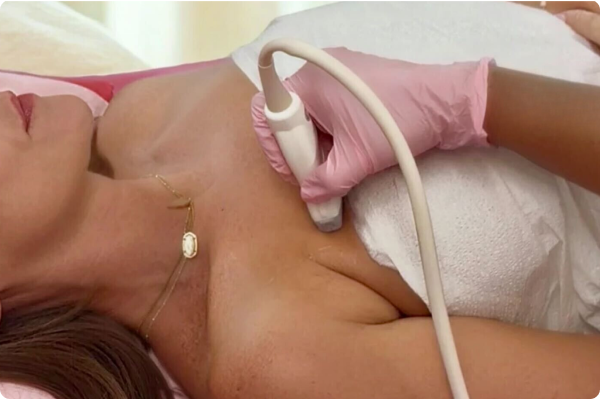
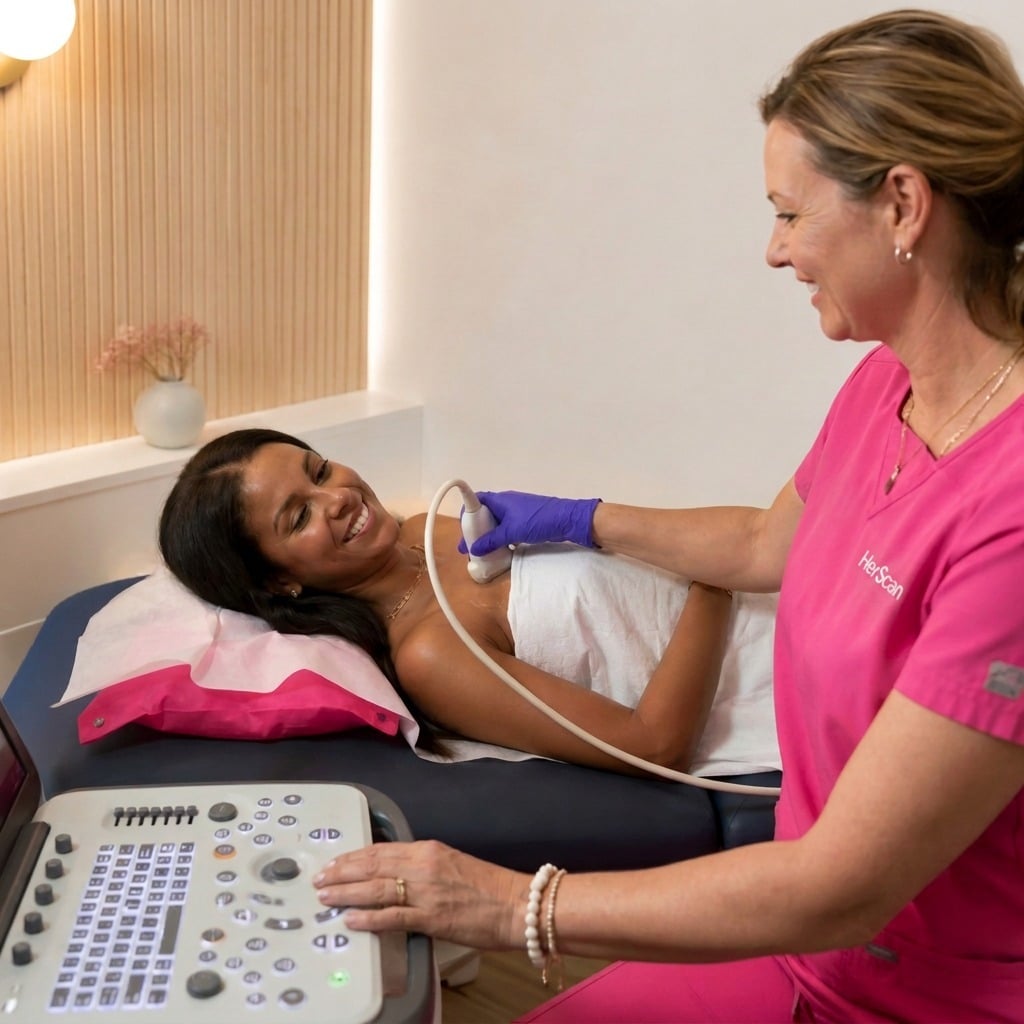
During your appointment, a probe glides over both breasts and the axilla area, without compression or discomfort.

Checks for abnormalities in breast tissue
When combined with mammography, breast ultrasound has been shown to increase early cancer detection rates up to 96% for women with dense breasts.

High accuracy for implant surveillance
In studies, ultrasound showed ~90.9% sensitivity and 100% specificity for silicone implant rupture detection.
.svg)
No referral or doctor's order needed
Eliminating barriers to breast screenings is our mission. No prescription or referral from a doctor is required.
Breast Ultrasound Screening (Plus Implant Integrity)
Many breast changes develop quietly. Ultrasound helps screen breast tissue and the underarm region, even if you don’t feel symptoms. If you have implants, ultrasound can also evaluate implant integrity—because some ruptures (especially silicone) can be “silent.”
Who needs a breast implant screening?
More than 1–2 million women in the U.S. have breast implants, and the chance of complications like leak or rupture increases as implants age
Silicone ruptures can be “silent,” meaning you may not notice symptoms right away—so imaging is often how changes are detected early
Over time, many people ultimately need removal or replacement—often due to rupture, capsular contracture, or other issues
Why women screen, even when everything feels “fine”
Check implant integrity for possible rupture/leak (silicone or saline)
Get reassurance after years with implants, before travel, or before/after major life changes
Evaluate new changes like firmness, swelling, lumps, shifting, rippling, or discomfort
Especially effective for screening dense breast tissue, which affects about half of women in the U.S.
 All of our equipment is certified by the American College of Radiology
1) Intracapsular rupture (shell tear, but the body’s fibrous capsule is still intact)
Silicone stays within the capsule, so the breast may look/feel normal (“silent rupture”).
What ultrasound can show:
-
Stepladder sign: The collapsed shell is seen within the gel; this is one of the most reliable ultrasound signs of intracapsular rupture.
-
Subcapsular line sign: a thin line parallel to the capsule representing a minimally collapsed shell/leak within the capsule.
-
Teardrop–type appearance: related to silicone tracking around a fold and subtle shell failure.
2) Extracapsular rupture (shell tear and capsule tear)
Silicone escapes beyond the capsule into breast tissue and/or lymph nodes.
What ultrasound can show:
-
Snowstorm sign: This is caused by free silicone droplets in tissue and is considered the most reliable sign of extracapsular silicone rupture.
-
Silicone in axillary lymph nodes can also create a snowstorm-like appearance.
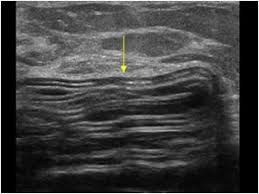
A high-frequency probe is used to survey the implant systematically in multiple planes, tracking the shell interfaces and looking for internal shell fragments or lines.