
Disclaimer: The following is not intended to be medical advice. Please consult with your doctor before making any medical decisions.
Noticing a new lump, tenderness, or change in your breast can bring up a lot of questions. It’s completely natural to feel concerned, and it’s always worth paying attention to changes in your body. The reassuring news is that many breast lumps are not cancerous. In fact, most of the time breast lumps are benign, and breast cysts account for around 25% of all breast masses.
When you notice a breast change, it’s normal to want clarity. The best way to understand what’s going on is to have the lump or change evaluated by a healthcare professional. Staying familiar with your body and keeping up with recommended screenings can help support early detection and give you more confidence in your breast health.
Read: How to Do a Breast Self-Exam: A Step-by-Step Guide
Breast lumps can feel similar, even when they have very different causes. A cyst is typically a fluid-filled sac, while a tumor is a solid mass, but that difference isn’t always obvious by touch alone. That’s why imaging tools like breast ultrasound and mammography can be helpful. They allow your healthcare provider to take a closer look and decide whether any additional follow-up, such as a biopsy, is needed.
What Are Breast Cysts?
Breast cysts are fluid-filled or air-filled sacs that form within the breast tissue. They may appear alone or as part of a small network of cysts. You may also see them in one or both breasts.
Breast cysts vary widely in size and appearance. Some are large enough to see and feel on the surface. Others are only visible with imaging. Any noticeable change in your breast should be checked out even if you strongly suspect it's a cyst. Even a cyst that has already been looked at needs a revisit if it changes.
Common signs of breast cysts may include:
- A round or oval lump in the breast
- A growth with smooth edges
- A lump that moves slightly under the skin
- A soft, fluid-like, or sometimes firmer texture
- Swelling or fullness near the lump
- Tenderness or localized breast discomfort
- Changes in lump size around your menstrual cycle
- Nipple discharge
While these signs can be associated with breast cysts, any new breast lump or change should be checked by a healthcare professional for clarity and peace of mind.
Types of Breast Cysts: Simple, Complicated, and Complex
Your care provider will identify your cyst as one of three types. The category of cyst doesn't indicate whether it's cancerous. It simply helps your provider to decide the next step.
- Simple Breast Cyst: A simple cyst in the breast small sac filled with fluid that's completely benign. It will have a round or oval shape with clean borders. Up to 90% of breast cysts are categorized as simple.
- Complicated Breast Cyst: A sac that contains cloudy fluid with floating blood or protein. While usually benign, they could have up to a 2% chance of being cancerous.
- Complex Breast Cyst: These cysts have thicker walls and solid debris and nodules. Cancer risk can be as high as 20%.
Are You More Prone to Breast Cancer If You Have Cysts?
A simple breast cyst does not increase your risk for breast cancer, which can be reassuring to know. However, breast health can be nuanced. Some women have what’s known as benign breast disease, or BBD, which refers to noncancerous changes in the breast, such as lumps, cysts, or tissue changes. While these changes are not cancer, they’re still worth discussing with your healthcare provider so you can understand what they mean for your personal breast health.Experts aren’t entirely sure why breast cysts form, but they are often linked to fluid buildup within the breast glands. Hormonal changes may also play a role, which is why some cysts can change in size or tenderness throughout the menstrual cycle. Breast cysts are most commonly seen in premenopausal women, especially those in their 30s and 40s, though they can also occur after menopause.
Women who use hormone therapy may also be more likely to develop breast cysts. In some cases, symptoms that feel similar to a cyst may have another cause, such as changes related to breast implants, including implant rupture or other implant-related concerns.
How Are Breast Cysts Diagnosed?
Breast ultrasound screening is the gold standard for cysts. A complete checkup includes a physical exam and a diagnostic breast ultrasound.
Ultrasound sound waves passing through a lump indicate it's a fluid-filled simple cyst. If waves echo back, solid matter is present. This requires additional testing. Your provider may recommend a mammogram if your ultrasound reveals a complex or complicated cyst.
Simple cysts don't require treatment. Your provider will advise you to monitor and wait. Treatment is available if your simple cyst causes discomfort.
Complicated and complex breast cysts may need additional follow-up, depending on how they look on imaging. In many cases, a complicated cyst can be monitored, aspirated, or biopsied if your provider wants more information. Complex cysts are more likely to need a biopsy because they can contain both fluid and solid areas. Surgery is not usually the first step just to “rule out cancer,” but it may be recommended in certain situations based on imaging results, biopsy findings, symptoms, or your provider’s clinical judgment.
Treatment for Breast Cysts
In many cases, simple breast cysts do not need treatment, especially if they are not causing discomfort. Some cysts may go away on their own over time. If a cyst is large, tender, or uncomfortable, your healthcare provider may recommend draining the fluid to help relieve symptoms. Even when treatment is not needed, it’s still important to have any new lump or breast change evaluated so your provider can confirm what it is and recommend the right next step.
Cyst vs Tumor Differences
Breast changes are worth paying attention to, especially when you notice a new lump, thickening, or area that feels different from your usual breast tissue. The best next step is to have it evaluated by a healthcare professional, who can help determine what it is and whether any follow-up is needed.
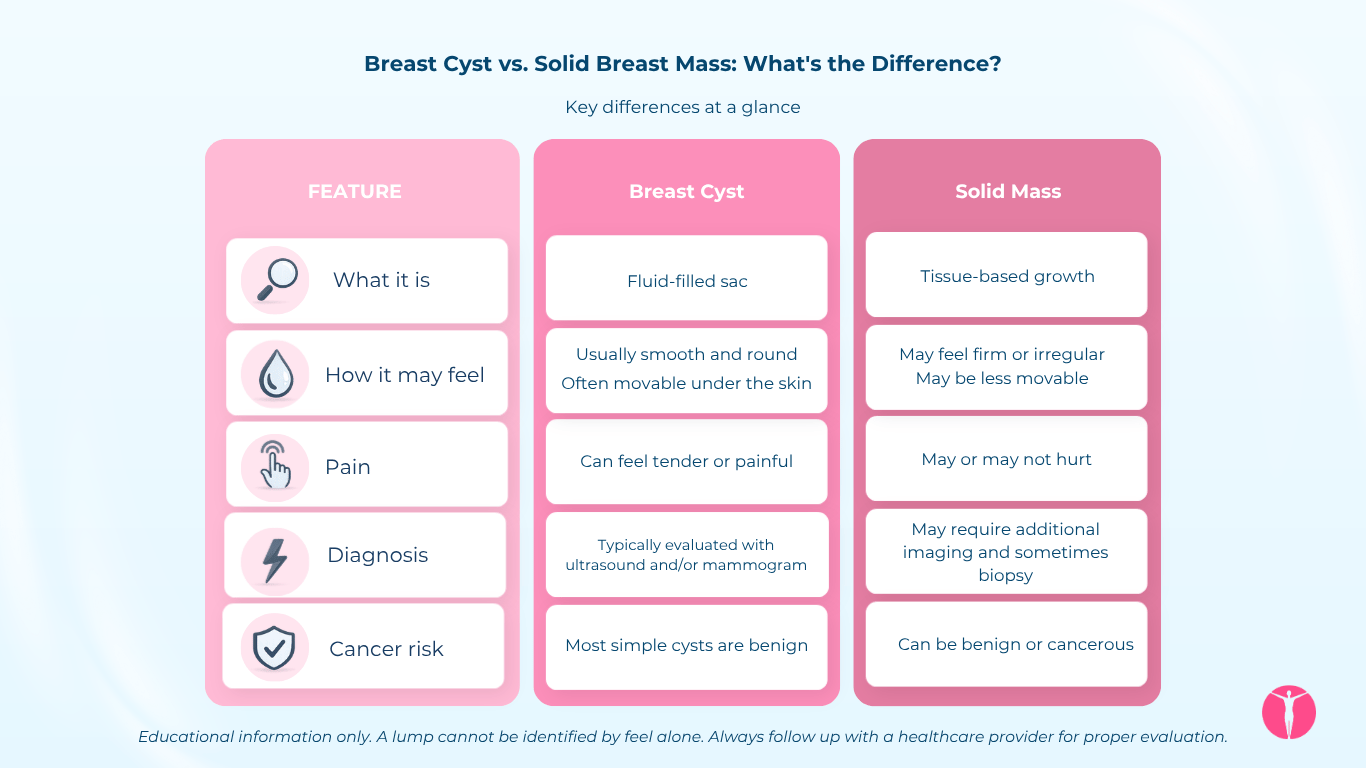
In the meantime, it may help to understand the difference between cysts and solid masses. A breast cyst is a fluid-filled sac, while a solid mass may be caused by a benign growth, such as a fibroadenoma, or by something that needs closer evaluation. Although cysts are often softer or more movable, and solid masses can feel firmer, touch alone is not enough to tell the difference.
Non-cancerous breast tumors can be made from a variety of things. Most contain normal breast particles that have turned abnormal. This includes fat, fluid, gland tissue, and connective tissue. Common types of benign breast tumors other than cysts include:
- Fibrocystic breast changes: Common changes that can cause lumpiness, tenderness, or swelling, often around the menstrual cycle.
- Mammary duct ectasia: A benign condition where the milk ducts widen, thicken, or fill with fluid, sometimes causing nipple discharge or tenderness.
- Fibroadenoma: A common benign breast lump made of glandular and connective tissue. These often feel smooth, firm, or rubbery and may move slightly under the skin.
- Calcifications: Small calcium deposits that show up as white spots on a mammogram. Many are related to normal breast tissue changes, though some patterns may need a closer look.
- Central intraductal papilloma: A small, usually benign growth inside a milk duct that may cause clear or bloody nipple discharge.
- Papillary apocrine change: A benign microscopic change in the cells lining breast ducts or cysts. It is usually found during imaging follow-up or biopsy rather than felt as a lump.
- Pseudoangiomatous stromal hyperplasia, or PASH: A benign overgrowth of breast connective tissue that can sometimes form a firm, movable lump.
Why HerScan for Breast Cancer Screening?
Breast ultrasound is a helpful tool for evaluating breast lumps because it can show whether an area appears fluid-filled, solid, or a combination of both. This information helps your healthcare provider better understand what may be causing the lump.
If imaging shows a simple fluid-filled cyst, your healthcare provider may recommend monitoring it, especially if it is not causing discomfort. If an area appears solid, complex, or unclear, additional follow-up may be recommended, such as diagnostic imaging, aspiration, or a biopsy to better understand what’s going on. Getting clear information can help you feel more confident about your next steps and more connected to your breast health.
HerScan makes breast ultrasound screening simple, comfortable, and convenient. Our ultrasound screenings are radiation-free and performed by experienced, certified female sonographers, with results interpreted by board-certified radiologists. Schedule your screening today and take a proactive step in your breast health routine.