
Disclaimer: This article is intended for informational purposes only. Do not rely on the information in this article as medical advice. Before making decisions about your breast health or screening plan, consult your doctor or healthcare provider.
Why Being Proactive About Your Breast Health Matters
Being proactive about your breast health isn’t about living in fear. It’s about feeling informed, empowered, and prepared. While no single habit, test, or lifestyle choice can completely prevent breast cancer, early detection can make a life-changing difference. When breast cancer is found while it is still localized, the 5-year relative survival rate is over 99%. That’s why building a breast health routine matters.
No one strategy can entirely prevent breast cancer. But there are some practices and evidence-based steps you can take to catch potential changes early.
Here are five evidence-based ways to create a personalized, proactive breast health routine that supports early detection and helps you take charge of your well-being.
#1 Know How to Perform a Self‑Breast Exam
Self‑breast exams don’t replace screenings by your healthcare provider. However, they can help you become familiar with how your breasts normally feel and look. This can make it easier to catch changes early.
Self‑awareness isn’t a diagnostic tool, but it can prompt you to follow up with a provider, which is a key part of proactive breast health.
How often should you do self‑breast exams?
Ideally, you should do self exams once a month, optimally several days after your menstrual cycle ends. This is when breasts are least tender. If you don’t menstruate, choose the same day each month.
For step‑by‑step guidance, see this article: How to Do a Breast Self‑Exam
#2 Know Your Breast Density
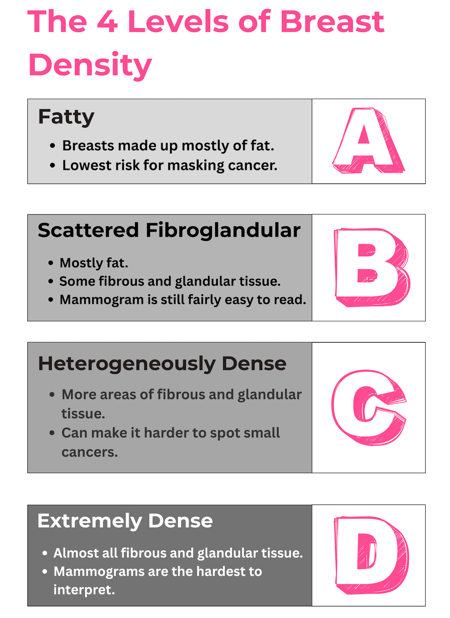 Breast density is the amount of glandular and fibrous tissue in your breasts relative to fatty tissue. Dense breast tissue is common and not considered abnormal or a disease. Dense breast tissue does not turn into cancer but it can make cancers harder to detect on a mammogram.
If you have dense breasts, it may be harder for a mammogram to spot cancer because dense tissue and tumors can appear similar on the imaging.
There are four breast density categories, ranging from almost entirely fatty to extremely dense.
A - The breast is made up of nearly all fatty tissue.
B - There is mostly fatty tissue, but some pockets of dense tissue exist in the breast.
C - Most of the tissue is dense, but there are some scattered areas of fatty tissue.
D - Almost all of the breast tissue is dense with little fatty tissue.
Here are some questions to ask your healthcare provider:
- Do I have dense breasts? What category am I in?
- How often should I be screened, given my density category?
- Should I get additional screening?
Asking your doctor or healthcare provider these questions can empower you to choose the right screening frequency and tools.
#3 Understand Your Family History
Family history can significantly influence your breast cancer risk, even if the relatives affected are on your father’s side. Therefore, it’s important to know your family history of breast cancer for both your mother's and father’s sides of the family.
Talk with your family about:
- Has anyone in our family had breast cancer?
- What age were they when diagnosed?
- Has anyone had ovarian cancer?
- Has anyone ever had genetic testing for BRCA1, BRCA2, or other hereditary cancer genes? If so, what were the results?
If you have a family history of breast cancer, consider speaking with your healthcare provider about genetic counseling or testing and working with a high-risk breast center to better understand your overall risk and a personalized screening plan.
Talking with family members about your health history can give your provider important insight into your personal breast cancer risk. Details like which relatives have had breast or ovarian cancer, their age at diagnosis, and whether genetic testing was involved may help determine whether earlier or more frequent screening is right for you.
These conversations don’t have to feel intimidating or formal. Sometimes, they can start with a simple check-in: “I’m learning more about my breast health and wanted to ask a few questions about our family history.”
Learn more about how family history influences risk.
#4: Know the Signs That Something May Be Off
Being proactive about your breast health also means knowing when something might be off. Here are some things to look for. Contact your healthcare provider if you notice any of these signs:
- A firm lump or an area that feels firm
- Swelling in the armpit or breast
- Bloody or unusual nipple discharge
- Persistent breast pain (especially in one spot)
Changes in appearance can also be a sign of breast cancer. These may include:
- Changes in breast size or shape
- Nipple inversion (turning inward)
- Skin puckering or dimpling
- An orange peel appearance on your breast (peau d'orange)
- Rash, redness, or changes in texture
These are signs of the most common breast cancers. But some cancers, including inflammatory breast cancer, don’t present with a lump. However, they may cause skin thickening, swelling, redness, or pain.
It’s important to take changes seriously, even if you don’t think they are anything. Many breast cancers begin with subtle changes. These are often easy to dismiss at first. Early evaluation is important. It can make a significant difference.
Read this helpful guide to learn more: Signs and Symptoms of Breast Cancer
#5: Schedule Risk‑Based Screenings
Risk-based screening takes a more personalized approach to breast cancer detection. Instead of relying only on general age-based guidelines, it looks at your individual risk factors to help determine when you should start screening, how often you should be screened, and whether you may benefit from additional imaging.
The American College of Radiology recommends that all women have a breast cancer risk assessment by age 25, especially those who may be at higher risk, so providers can identify whether earlier or more intensive screening may be appropriate.
Your recommended screening plan may be influenced by your unique risk profile, including factors such as:
- Personal medical history: Benign breast conditions and other medical issues can increase the risk.
- Genetic factors: Gene mutations, such as BRCA1 and BRCA2, can significantly increase the likelihood of developing breast cancer.
- Breast density: Dense breasts may necessitate more frequent screening.
- Family history: A family history of breast, ovarian, and other cancers on either side of the family increases the risk of breast cancer. Therefore, you may need earlier or more frequent screenings.
- Lifestyle or environmental exposures: Examples include being exposed to certain chemicals (like formaldehyde, which may be in makeup), and alcohol use can play a role in risk.
Why HerScan for Breast Cancer Screening
Being proactive starts with awareness, but it continues with action. Once you understand your family history, risk factors, and breast density, you can follow up with the right screening.
HerScan offers convenient breast ultrasound screening designed to add another layer of insight to your breast health routine. This can be especially helpful for women with dense breast tissue, since dense tissue can make it harder for mammograms to clearly show certain abnormalities. Ultrasound uses sound waves to provide a closer look at breast tissue and may help detect findings that are not as visible on mammography alone.
Used alongside your recommended mammogram, breast ultrasound can be a powerful supplemental screening tool, helping you and your provider make more informed decisions about your care.
HerScan makes breast ultrasound screening comfortable, accessible, and convenient with:
- No referral required: You can schedule a screening on your terms when you are ready.
- Quick appointments: Most screenings take just 20 minutes. This makes it easy to fit into a busy schedule.
- Highly trained sonographers: Each scan is performed by a certified, female sonographer.
- Transparent, affordable pricing: Clear up-front pricing so you know what to expect.